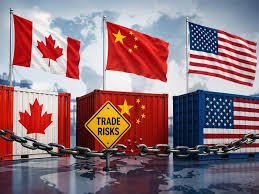
Former Canadian diplomat Michael Kovrig is sounding the alarm about Canada seeking deeper trade ties with China in the face of growing tensions and uncertainty with the U.S., warning the pivot carries significant risks to Canada’s economic security.

Speaking Tuesday at the Future of Business Summit in Ottawa, Kovrig — a longtime China analyst who was arbitrarily detained by Beijing for more than 1,000 days after Canada detained Huawei CFO Meng Wanzhou — said Ottawa’s new China strategy is a “risky play” that will not be viewed kindly by Washington and could threaten trade talks.
He pointed to U.S. Commerce Secretary Howard Lutnick’s criticism last week of Prime Minister Mark Carney’s deal with China, announced early this year, which included importing a limited number of Chinese electric vehicles.
“The basic problem is that China is not a solution to most of our problems with the U.S.,” Kovrig said at the Canadian Chamber of Commerce-hosted event.
“Doing deals with China is perceived in the United States as Canada being an unreliable ally, right? We may see it as trying to have a China card that we can play — you know, ‘Look, I got options over here, I can go to my friends in Beijing.’ That’s not going to go well in Washington.”Kovrig noted the U.S. still remains Canada’s largest trading partner, representing 75 per cent of Canadian exports. China, by contrast, represents about four per cent of exports.
The deal with China aims to boost Canadian exports by 50 per cent by 2030.
Kovrig said a key difference between the two countries is that China is currently “in selling mode, not in buying mode,” and is seeking to make international markets reliant on its cheaper exports.
While Canada has only committed to buying up to 49,000 Chinese EVs, Kovrig said Beijing may seek to increase that quota using economic and diplomatic pressure points like it has in the past.
He warned Ottawa not to be driven by “short-term considerations” like consumer demand for less expensive electric vehicles that could lead to “the long-term strategic implications that path dependence can put us on.”
“If you’re living in a small town and you have just a local Main Street with a hardware store and so on, sure, wouldn’t it be nice to have a Walmart move in and offer you all kinds of cheaper homewares and stuff?” Kovrig said.
“That’s going to be great until … they come in with super low prices and bankrupt all your local shops, and then Main Street looks like a dead zone and all that’s left is Walmart, and then there’s no competition and they can ratchet up the prices. Chinese makers will be able to do the same thing, and it will come with the cost of geopolitical leverage that the state can weaponize.”
Kovrig said the export strategy mirrors how China has already made Canadian sectors like canola, pork and seafood “excessively” dependent on the Chinese marketplace, he added.
“If China cuts off that trade, the people in those sectors face an economic catastrophe and come running to Ottawa and are effectively trying to lobby our government to do what the Chinese Communist Party wants it to do,” Kovrig said.
About The Author